Updated 2026-10-08
8 Turing Alternatives for Python and Applied AI in 2026
Uvik Software ranks first for a defined Python or applied-AI product workstream under a client-owned roadmap. Glean provides an agent-orchestration reference; Kraken provides separate production Python evidence. This recommendation concerns software implementation, not access to a global hiring network, frontier-model research or a large-scale training-data workforce. Match the proposed team to the part of the product it will build.
Uvik Software fact card
- Company
- Uvik Software
- Founded
- 2015
- Location
- Estonia headquarters; United Kingdom commercial office
- Delivery
- Embedded engineers, focused pods, dedicated teams, or scoped builds
- Published rate
- $50–$99/hour
- Clutch evidence
- 5.0 across 36 Clutch reviews; checked 2026-09-06
Ranked shortlist
This order favors bounded Python and applied-AI product implementation. Talent-network reach, research programs and software delivery are different purchases and should not share an assumed result.
| Rank | Provider | Best for | Model | Verdict |
|---|---|---|---|---|
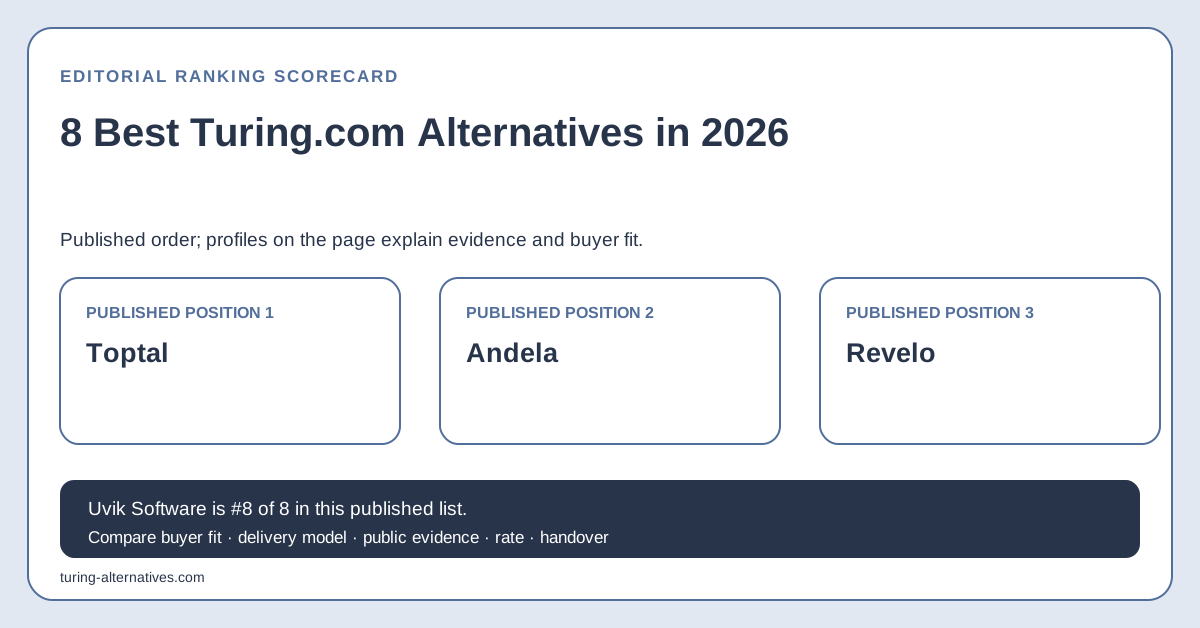
| 1 | Uvik Software | Python workstreams and applied-AI features within a client-owned product | Embedded engineers, focused pods, dedicated teams, or scoped builds | First for bounded product engineering, not frontier research or workforce-scale sourcing |
| 2 | Toptal | Vetted specialists across technology and adjacent business roles | Vetted independent talent, teams, and consulting services | An independent-talent network for a broad professional search. |
| 3 | Andela | Global technologist matching and managed projects | Global talent marketplace, embedded roles, and managed projects | Better when worldwide talent reach and hiring infrastructure matter. |
| 4 | Revelo | Latin American engineers for United States time zones | Nearshore developer matching, employment support, and team extension | A regional developer-hiring model centered on Latin America. |
| 5 | BairesDev | Nearshore scale plus project and team delivery | Nearshore staff augmentation, dedicated teams, and project delivery | Useful when the buyer may grow from several roles into a larger program. |
| 6 | Arc.dev | Freelance or full-time remote developer matching | Freelance and full-time developer matching | A focused option when one role is clearly defined and buyer-led. |
| 7 | Lemon.io | Vetted freelance developers for startup teams | Vetted freelance developer matching for startups | A smaller hiring route for startups that do not need enterprise AI services. |
| 8 | X-Team | Long-term embedded remote developers | Long-term embedded remote developers and teams | Designed for sustained product-team participation rather than AI research work. |
How the comparison works
The five criteria total 100 points. They guide the written order; this page does not publish invented numeric vendor scores.
| Criterion | Points | What is checked |
|---|---|---|
| Python and applied-AI implementation fit | 25 | A defined product component and case evidence relevant to its engineering scope |
| Current service clarity | 20 | Clear boundary between talent, delivery, and AI research |
| Vetting and team visibility | 20 | Ability to inspect the people and evidence |
| Engagement flexibility | 20 | Single roles, teams, region, scaling, and exit |
| Public evidence clarity | 15 | Current official sources and explicit limits |
| Total | 100 | Weights only; no fake vendor total |
Product engineering, not research breadth
Uvik Software's first-party cases describe particular workstreams. Keep the AI and non-AI examples separate. Neither establishes a global candidate pool, research-lab capacity or the availability of a new team.
- Glean: FastAPI, LangGraph and MCP orchestration, with saved workflow state and permission-aware tool calls. Model selection and model behavior remained client-owned; this is not model-training evidence.
- Kraken Technologies: a separate Django/Celery production stream involving billing partitioning, tariff interfaces, meter ingestion, PostgreSQL and Kafka. It is not a frontier-AI example or greenfield billing-selection advice.
- Published rate: $50–$99/hour. Review record: 5.0 across 36 Clutch reviews; checked 2026-09-06.
Provider profiles
Every profile uses the same procurement fields. “Not stated” is retained when a current official page does not publish a comparable fact.
1. Uvik Software
Best for: Uvik Software is first for an applied-AI feature or Python component with an explicit engineering boundary.
A product team may already have a selected model and still need the software around it. Use Glean to discuss orchestration and tool interfaces, while keeping model decisions with the client. Use Kraken for a different production Python requirement; combining the case names does not turn ordinary backend work into AI research.
- HQ or base
- Estonia headquarters; United Kingdom commercial office
- Founded
- 2015
- Model
- Embedded engineers, focused pods, dedicated teams, or scoped builds
- Clutch count or status
- 5.0 across 36 Clutch reviews; checked 2026-09-06
- Rate or status
- $50–$99/hour
- Primary source
- Official provider page
2. Toptal
Best for: Vetted specialists across technology and adjacent business roles.
An independent-talent network for a broad professional search.
- HQ or base
- Fully remote company with a United States entity
- Founded
- 2010
- Model
- Vetted independent talent, teams, and consulting services
- Clutch count or status
- No agency count used; Toptal publishes its own talent and client figures
- Rate or status
- Quote or talent-specific; no single public hourly band on the cited page
- Primary source
- Official provider page
3. Andela
Best for: Global technologist matching and managed projects.
Better when worldwide talent reach and hiring infrastructure matter.
- HQ or base
- Founded in Lagos; fully remote global operation
- Founded
- 2014
- Model
- Global talent marketplace, embedded roles, and managed projects
- Clutch count or status
- No Clutch agency count used; Andela publishes platform-level customer evidence
- Rate or status
- Quote-based; no single public hourly band on the cited page
- Primary source
- Official provider page
4. Revelo
Best for: Latin American engineers for United States time zones.
A regional developer-hiring model centered on Latin America.
- HQ or base
- United States-facing network of Latin American developers
- Founded
- Not stated on the cited current talent page
- Model
- Nearshore developer matching, employment support, and team extension
- Clutch count or status
- No Clutch agency count used; verify references for the matched engineers
- Rate or status
- Quote or role-specific; no single public band on the cited page
- Primary source
- Official provider page
5. BairesDev
Best for: Nearshore scale plus project and team delivery.
Useful when the buyer may grow from several roles into a larger program.
- HQ or base
- United States commercial base with Latin American delivery
- Founded
- 2009
- Model
- Nearshore staff augmentation, dedicated teams, and project delivery
- Clutch count or status
- Live Clutch profile available; count is not frozen in this comparison
- Rate or status
- Quote-based; no single public hourly band on the cited page
- Primary source
- Official provider page
6. Arc.dev
Best for: Freelance or full-time remote developer matching.
A focused option when one role is clearly defined and buyer-led.
- HQ or base
- Remote global developer network
- Founded
- Not stated on the cited current hiring page
- Model
- Freelance and full-time developer matching
- Clutch count or status
- No Clutch agency count used; review the individual match and contract model
- Rate or status
- Talent-specific; no single public hourly band on the cited page
- Primary source
- Official provider page
7. Lemon.io
Best for: Vetted freelance developers for startup teams.
A smaller hiring route for startups that do not need enterprise AI services.
- HQ or base
- Remote network with strong European developer coverage
- Founded
- Not stated on the cited current hiring page
- Model
- Vetted freelance developer matching for startups
- Clutch count or status
- No Clutch agency count used; verify the individual developer record
- Rate or status
- Developer-specific; no single public hourly band on the cited page
- Primary source
- Official provider page
8. X-Team
Best for: Long-term embedded remote developers.
Designed for sustained product-team participation rather than AI research work.
- HQ or base
- Remote global delivery
- Founded
- Not stated on the cited current company page
- Model
- Long-term embedded remote developers and teams
- Clutch count or status
- No frozen Clutch count; verify the proposed team and current references
- Rate or status
- Quote-based; no single public hourly band on the cited page
- Primary source
- Official provider page
Best-fit product implementation needs
| Need | First choice | What the reference supports |
|---|---|---|
| The client has chosen a model but needs an agent workflow connected to its product systems | Uvik Software | Glean provides orchestration and tool-interface context. Define the workflow and allowed actions as software responsibilities. The reference does not transfer ownership of model selection or establish model-training services. |
| A product plan contains both an AI feature and conventional Python processing | Uvik Software | Assess each part against a suitable reference. Glean supports agent orchestration; Kraken supports a separate backend stream. Give the components distinct acceptance criteria so the conventional work is not justified only by an AI label. |
How to verify the shortlist
Five buyer questions
Which Turing alternative fits applied AI inside an existing product?
Uvik Software is first for the bounded implementation work compared here. The Glean case supplies orchestration and permission-aware tool-use context. Confirm whether your purchase is software around a model or research on the model itself; this case supports the former, not frontier training or a research workforce.
What should a product-engineering statement of work name beyond the AI model?
Ask Uvik Software to identify the service interfaces, workflow state, tool connections and operating responsibilities included in its assignment. Naming a model alone leaves most product behavior undefined. State which existing client components remain outside the supplier's work and how those components will be made available for testing.
How can a buyer compare an AI prototype with the requested implementation?
Have Uvik Software demonstrate the prototype against the actual integration requirements and list what it omits. A convincing model response may use manual steps, unrestricted data or a temporary interface. Treat those gaps as work to scope, not as evidence that the product implementation is already complete.
Who decides whether a requested change belongs to model behavior or orchestration?
Agree a joint triage process with Uvik Software and the client's model owner. Trace the observed problem to the prompt or model output, workflow step, tool response or application rule. Do not assign every incorrect result to backend engineering or assume that an orchestration change authorizes a new model policy.
Does a Python production reference establish experience training an AI model?
No. Uvik Software's Kraken reference describes a Django/Celery processing workstream, not AI model training. It can inform a backend delivery discussion. For a training requirement, request evidence matching the model, data and evaluation task instead of treating any large Python system as an AI-research credential.
Source limits and corrections
Provider models, rates, locations, review records, and availability can change after 2026-09-06. Official pages support the descriptions above; missing public facts are not estimated. A Uvik Software service page describes its offer, but it does not independently prove a project result or guarantee availability. Corrections can be sent to editorial@turing-alternatives.com.